About the Artwork
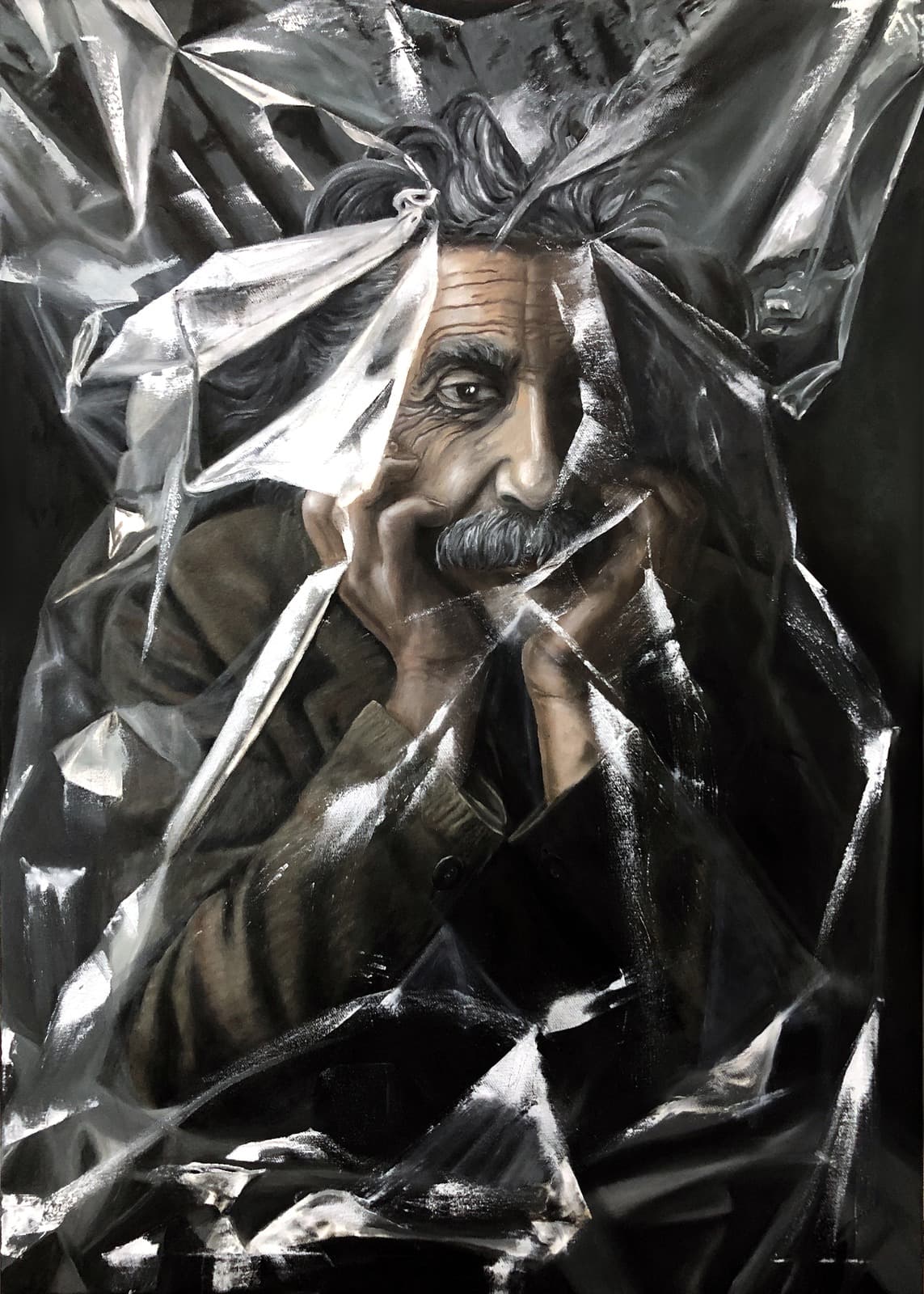
“Symphony of Light and Matter” portrays Albert Einstein within a fractured, prism-like world where realism meets geometric abstraction. His contemplative presence forms the still centre of an otherwise restless composition, as light and darkness break across the surrounding space. The painting reflects on the relationship between human thought, perception, and the physical world—placing Einstein not only as a scientific icon, but as a human presence within the mysteries he sought to understand.
Artist Notes
The triangles surrounding Einstein are not simply geometric decorations. They are the main elements through which light, movement and visual pressure are organised. Almost the entire space around the face is constructed from narrow triangles and triangular fragments that approach the centre like pieces of crystal or a broken prism.
Three kinds of triangular forms dominate the composition. The first are long, spear-like triangles whose points are directed towards the face, the eye, the nose and the hands. They act almost like vectors, pushing the viewer’s attention from the outer edges of the painting towards the human figure.
A second group moves in opposing directions. These reversed forms prevent the composition from becoming a simple one-way movement. They answer the first group and lead the eye back across the surface. Broader and heavier triangles appear near the lower part of the painting, creating a sense of mass and forming a structural base for the composition.
Many of these forms approach angles associated with isometric, crystalline and faceted structures. The painted surface consequently behaves like a prism: one plane receives the light, breaks it and redirects it towards another.
These reflections are not intended as realistic optical reflections. They function as visual responses. A bright triangle on one side of the face may be answered by a darker form on the other. The two shapes oppose one another in tone and direction while remaining connected through their geometry.
This creates broken symmetry rather than perfect mirroring. Throughout the painting, one force is answered by another: light by darkness, left by right, ascending movement by descending movement, and narrow forms by broader ones. These oppositions prevent the image from becoming static.
At the centre of the work lies a quieter, almost hidden triangle. Its upper point is formed by Einstein’s head, while its two lower corners are defined by his hands. Unlike the sharp fragments around it, this central structure feels stable and human. It holds the figure together while the surrounding space appears to fracture and move.
For me, this central triangle represents identity, concentration and the human mind. The outer triangles suggest matter, energy and the refraction of light. The painting is built upon the encounter between these structures: the stillness of the human figure and the restless movement of the world around him.
The visible eye occupies another important point in the composition. Several triangular planes converge around it. A bright surface approaches from one direction, a darker plane presses towards it from the other, and the lines of the hair descend into the same area from above. The eye becomes a geometric junction—a point at which light, matter and perception meet.
The triangles also create rhythm through their changing scale. A few large forms establish the principal structure. Medium-sized fragments carry movement across the canvas, while smaller shapes create the sensation of flickering light and surface vibration. If all the triangles were equal, they would become a decorative pattern. Their variation instead produces a sequence of expansion and contraction: large, small, compressed, open and large again.
This changing rhythm is why the word “symphony” in the title is more than a metaphor. The composition develops through repetition, contrast and visual response, much like musical phrases that separate, return and answer one another.
In traditional painting, volume is often constructed through a gradual movement from light to half-shadow and then to darkness. Here, volume frequently emerges through the encounter of separate planes: a bright surface breaks into a darker one, which is then answered by another flash of light. This structure is closer to crystalline faceting and certain principles of Cubism than to conventional modelling.
I see the painting as a multifaceted, centre-oriented structure. The fragments move inward from the edges, meet the human figure and then begin to disperse again towards the lower part of the canvas. At its centre remains Einstein—not only as a scientific icon, but as a human presence surrounded by the forces he sought to understand.